Showing posts with label Environmentalism. Show all posts

Thursday, July 17, 2008

Perhaps I Should Consider Moving

The Environmental Protection Agency published a study today warning Southern states to expect serious consequences from the ongoing effects of global warming. Gulf Coast states are most at risk.

...The Gulf Coast states, in particular, will be hit with more flooding and other problems from more frequent and intense storms and forest fires, according to the federal report. Other effects expected in the South include higher air pollution and a longer pollen season...

Commenters at al.com immediately showed their less than stellar reading comprehension by going on the attack against Al Gore and "bed wetting wackos". Those are presumably the liberal, environment-lovin' wackos of the Bush Administration's EPA. I wasn't aware they had hired Al Gore.
More...

However, all is not lost. I scrolled down a bit and found this comment from truthsleuth:

Here's the way I look at it - just in case, wouldn't it be best to address global warming than debating if it is real or not? Because if it is real, as most reputable scientists believe, and we spend all our time debating about it and doing nothing about it, we're in a heap load of trouble.

If it isn't real and we do something about it, we'll have less dependency on the profiteering of big oil companies in the middle east and at home; we'll have less dependence on monopoly utilities here at home; we'll reinvigorate our economy by reinvesting in aging infrastructure and new technologies; we'll improve our health by reducing air and water pollution; and more benefits.

Let's prepare ourselves for the potential impacts of global warming instead of debating over whether or not the sky is fall - just in case. In the end, no matter the validity of the global warming critics and supporters, if we take action now, we'll have a stronger economy, improved public health, and cleaner environment for generations to come. We have the solutions - let's put those solutions to work.

Common sense. What a concept!

Tuesday, January 29, 2008

Maybe Next Year He'll Get Around to It

2008:

Our security, our prosperity, and our environment all require reducing our dependence on oil....Let us fund new technologies that can generate coal power while capturing carbon emissions. Let us increase the use of renewable power and emissions-free nuclear power. Let us continue investing in advanced battery technology and renewable fuels to power the cars and trucks of the future. Let us create a new international clean technology fund, which will help developing nations like India and China make greater use of clean energy sources. And let us complete an international agreement that has the potential to slow, stop, and eventually reverse the growth of greenhouse gases.
2007:
Extending hope and opportunity depends on a stable supply of energy that keeps America's economy running and America's environment clean. For too long our nation has been dependent on foreign oil. And this dependence leaves us more vulnerable to hostile regimes, and to terrorists -- who could cause huge disruptions of oil shipments, and raise the price of oil, and do great harm to our economy.
2006:
Keeping America competitive requires affordable energy. And here we have a serious problem: America is addicted to oil, which is often imported from unstable parts of the world. The best way to break this addiction is through technology.
2005:
To keep our economy growing, we also need reliable supplies of affordable, environmentally responsible energy....Four years of debate is enough: I urge Congress to pass legislation that makes America more secure and less dependent on foreign energy. (Applause.)
2004:
Consumers and businesses need reliable supplies of energy to make our economy run -- so I urge you to pass legislation to modernize our electricity system, promote conservation, and make America less dependent on foreign sources of energy. (Applause.)
2003:
Our third goal is to promote energy independence for our country, while dramatically improving the environment. (Applause.) I have sent you a comprehensive energy plan to promote energy efficiency and conservation, to develop cleaner technology, and to produce more energy at home. (Applause.)
2002:
Good jobs also depend on reliable and affordable energy. This Congress must act to encourage conservation, promote technology, build infrastructure, and it must act to increase energy production at home so America is less dependent on foreign oil.
2001:
As we meet tonight, many citizens are struggling with the high cost of energy. We have a serious energy problem that demands a national energy policy. (Applause.) The West is confronting a major energy shortage that has resulted in high prices and uncertainty. I've asked federal agencies to work with California officials to help speed construction of new energy sources, and I have direct Vice President Cheney, Commerce Secretary Evans, Energy Secretary Abraham and other senior members in my administration to develop a national energy policy. (Applause.)

Thursday, January 10, 2008

Mount Diablo

Tamalpais and Diablo
Tamalpais (East Peak) and Diablo, from the Middle Peak of Tamalpais

Chronicle architecture critic John King, on my favorite Bay Area landmark:

Regions are all but impossible to define - even ones that, like the Bay Area, seem obvious on a map.

The orderly lines disappear in real life...The only way to keep your bearings is to grab hold of an anchor.

That means a landmark like Mount Diablo, the Contra Costa peak that is the vertical equivalent to the body of water that gives our region its name. You encounter it in places you'd never expect, and even though it never looks the same from any angle, you always know what it is. And where you are....

Sure, there are plenty of other Bay Area bumps....But Mount Diablo is different, rising from a long ripple of ridges with enough oomph that it's a thing unto itself rather than a culmination of hill upon hill. It also packs a one-two punch, a mountain that's a pair of peaks, one sharp and one soft.

There's also the way it rises with grand nonchalance from the suburbs nestled on the north and east. In spring it's a beckoning green, while in late summer the slopes resemble burlap, weathered but certain to endure....

The mountain's visual power also is heightened by the fact that so much of the terrain around it is undeveloped - a tribute to open space advocates and the group Save Mount Diablo, which was founded in 1971 and has helped Mount Diablo State Park grow from 6,788 to nearly 20,000 acres.

The wonder of the mountain, though, is the spell it casts from afar. It registers as a centerpiece, an orientation point that signals the connection between otherwise disparate parts of the region.

For instance, the sound-walled sprawl of eastern Contra Costa feels like it could be anywhere - except that to the west is Mount Diablo at its most abrupt, kicking into the sky from the orchards that remain. On the west side of the bay, meanwhile, the top of Mount Diablo is on view from vantage points above the shoreline of San Francisco's Bayview district. The mountain links these two realms that otherwise are worlds apart.

That's another thing I like about Mount Diablo: You encounter it constantly, without effort. Sometimes it spreads out like a glorious feast, especially when you're heading east from Orinda on BART or Highway 24, a gentle giant surrounded by a crowd of hillocks. Looking north from the Tri-Valley area, by contrast, it doesn't seem so much tall as broad. And if you're driving back into the region from the Central Valley, it's a distant glimpse that signals journey's end....

Plenty has changed for "Monte" since [1860]. There are roads, campgrounds, radio antennas and an aviation beacon that comes alive each Dec. 7. The landscape that unfurls below includes office towers, shopping malls and cities with more than 100,000 people....

But the next time you stand along the inner shoreline or move beneath Mount Diablo, consider: The essence of this place remains. It binds us. And we all have a stake in its future.
I first fell in love with Diablo 30 years ago, on a family outing not long after moving out here from New Jersey. Diablo seemed quintessentially Western--rugged, rocky, and dry--and I imagined filming a shootout among the outcroppings. To a kid fresh from exile in in the East, this was Home.

I still get a little thrill every time I see Diablo--and you can see it from all over. From Tamalpais, of course (35 miles). On a clear day I can catch a glimpse of it from the bus as we top the hill at Turk and Roselyn (30 miles). Coming home from Sacramento, Diablo is there most of the way. Working in Modesto for six weeks, I took comfort in being able to see a landmark that was also visible from near my home (53 miles).

Closer in, you notice two things. The first is that it's really, really big. Not huge like Rainier or Shasta, but huge by any human standard. It's a massive presence.

The second is how far the burbs have advanced since I first visited. King is right about the success of efforts to preserve the mountain...but they haven't all been victories, and the tract homes now march right up to the park boundary in some places. We've lost a lot over the years.

Still, enough was saved to be well worth celebrating--30,000 or so acres on the mountain, and another 50,000 or so in the outlying foothills. That parkland is a testament to the people who saw the value of this amazing landmark, and understood the necessity of preserving it.

Wednesday, January 02, 2008

Tierney and Global Warming 'Alarmists'

In skewering the wingnuts' reaction to that John Tierney column yesterday, I didn't didn't really deal with the column itself. It really is bad, though--bad enough to be worth a post in its own right.

Tierney is dishonest in a couple of ways here. First, he follows the popular strategy of picking at what people say about global warming in order to discredit the idea without addressing its substance. As S. W. Anderson points out, the existence of some overly-alarmist voices about global warming has no bearing at all on the reality of the phenomenon--any more than wingnut hysteria about Terra negates the existence of al Qaeda.

(Of course, Tierney may be making a virtue of necessity here, given that his own understanding of the substance appears to be cartoonishly wrong; for example, there is this:

Droughts in California and Australia became the new harbingers of climate change (never mind that a warmer planet is projected to have more, not less, precipitation over all).
Which is extremely silly: obviously, there is no contradiction between drought in some areas and more precipitation over all.)

The other key bit of dishonesty comes when Tierney identifies a class of "availability enterpreneurs" that lumps together "activists, journalists and publicity-savvy scientists"--implying that journalists and (non-denier) scientists are just as agenda-driven as the activists. Of course, the 'scientists' who are most agenda-driven and 'publicity-savvy' are the ones who shill for the corporations--which is why they have been so successful at confusing the issue. As usual, Tierney gets it completely wrong: it isn't global warming activists who run the well-oiled propaganda machine.

Tuesday, January 01, 2008

Be Afraid. Be Very Afraid. Or Not.

John Tierney continues his crusade to minimize global warming with a column titled In 2008, a 100 Percent Chance of Alarm :

I’d like to wish you a happy New Year, but I’m afraid I have a different sort of prediction.

You’re in for very bad weather. In 2008, your television will bring you image after frightening image of natural havoc linked to global warming. You will be told that such bizarre weather must be a sign of dangerous climate change — and that these images are a mere preview of what’s in store unless we act quickly to cool the planet....

Slow warming doesn’t make for memorable images on television or in people’s minds, so activists, journalists and scientists have looked to hurricanes, wild fires and starving polar bears instead. They have used these images to start an “availability cascade”....The availability cascade is a self-perpetuating process: the more attention a danger gets, the more worried people become, leading to more news coverage and more fear.
Naturally, this gets its share of links from the wingnuts. Blue Crab Boulevard castigates "global warming hysterics"; hysterics about Iran and IslamoLiberal Terra are perfectly okay. Newsbusters slams the Lieberal Em-Ess-Em for global warming "alarmism"...and for failing to be alarmist about Iran and terrists under our beds within our borders. A. J. Strata is dismayed at "another year of 'The Sky Is Falling'"...even as he warns of imminent sky-type descent from Iran and U.S.-based terrists.

Where Terra is concerned, we have nothing to fear but not enough fear itself. Catastrophic climate change--not so much.

Just to be clear, I'm not slamming Tierney for that. He's a hack, and aggressively stupid about some things (like global warming), but to his credit he has tried to put terrorism in perspective (and from today's article: "we overestimate the odds of dying in a terrorist attack or a plane crash because we’ve seen such dramatic deaths so often on television").

It's the reflexive wingnuts I'm talking about--the ones who judge truth or falsehood solely on the basis of party/ideological/tribal affiliation. Little things like the relative likelihood and magnitude of impact don't matter; what matters is that Al Gore warns of one peril (so it's just hysteria), and George Bush harps on the other (so it's the Ultimate X-Treem Clash Of Civilization-Type Armageddoniffic Danger! Danger! Danger!).

What a bunch of useless tools.

Thursday, November 08, 2007

VDH: If You're Part of the Solution, You're Part of the Problem

Shorter Victor Davis Hanson

Our addiction to oil is a bad thing...and the people trying to push conservation are as much at fault as the people pushing consumption.

Sunday, November 04, 2007

The Story of Lead

Elizabeth Kolbert, in a New Yorker review of Auto-Mania: Cars, Consumers, and the Environment by Tom McCarthy:

The earliest automobiles were designed to run on ordinary—which is to say, unleaded—gas. But in the nineteen-tens, as automakers began to experiment with higher-compression engines, the problem of “knock” arose....In 1921, a team of G.M. researchers looking for a way to prevent knock discovered that by adding small amounts of tetraethyl lead, or TEL, to the fuel supply they could solve the problem.

By that point, the toxicity of lead was already well known. Indeed, one of the G.M. researchers behind TEL, Thomas Midgley, very nearly poisoned himself while working on the additive, and several workers at a plant experimenting with TEL died gruesome deaths as a result of exposure to it. (Midgley went on to invent Freon, which was later discovered to be destroying the ozone layer.) In response to an outcry from public-health experts, G.M. and Standard Oil, which had formed a joint venture called the Ethyl Gasoline Corporation to manufacture leaded gas, launched a P.R. campaign. Among the arguments the companies made was that there simply were no alternatives to TEL, a claim that, according to McCarthy, there is reason to believe they knew to be false. (Already in the twenties, chemists proposed eliminating knock by increasing the octane level in gasoline, as was eventually done)....It took the federal government until the mid-nineteen-seventies to order its phase-out. By that point, G.M. had sold its interest in Ethyl, and automakers in general had turned against TEL, not because it caused brain damage but because it interfered with the operation of catalytic converters, an innovation that car manufacturers had also long resisted. It is estimated that by 1996, when the sale of leaded gasoline for use in cars was finally banned in the U.S., seven million tons of lead had been released from automobiles’ exhaust pipes into the air, and nearly seventy million American children had been exposed to what would now be considered dangerous blood-lead levels.
If stories like this were taught in every grade school in America, there would be fewer libertarians to annoy us.

Friday, September 21, 2007

National Parking Day

Dune Scrub 01

Catherine reminded me that today was National Parking Day, "an opportunity to transform public parking spaces into parks and open spaces - places for people to enjoy." So I checked the map to see what parks there were near my office, and set out on my lunch hour to get pictures. Above is Dune Scrub Community Park, an oasis of San Francisco native plants by McCall Design Group.

Living Room

Here I'm lounging in a comfy chair in the Living Room, courtesy of Field Paoli.

The execution is whimsical, but the intent is serious: to highlight the need for public open space, and the loss of same to automobile-dedicated space.

Update: d accuses me of selling out. I don't know...he might just have a point.

Thursday, August 30, 2007

Global-Warming Denialists and "Consensus"

As soon as the wingnuts get bored with Clinton's fundraiser, expect them to latch on to this: "Survey: Less Than Half of all Published Scientists Endorse Global Warming Theory".

This one is by Michael Asher, a blogger whose posts in the last month include: Latest Research Erodes CO2's Role in Global Warming, Major New Theory Proposed to Explain Global Warming, Blogger Finds Y2K Bug in NASA Climate Data (remember that one?), New Scandal Erupts over NOAA Climate Data, and 2007 Hurricane Season: Where's the Beef?

Single-minded much?

Anyway, this is about a study conducted by one Klaus-Martin Schulte along the lines of the Oreskes survey of published climate research. Here's Asher's characterization of the Schulte study:

Of 528 total papers on climate change, only 38 (7%) gave an explicit endorsement of the consensus. If one considers "implicit" endorsement (accepting the consensus without explicit statement), the figure rises to 45%. However, while only 32 papers (6%) reject the consensus outright, the largest category (48%) are neutral papers, refusing to either accept or reject the hypothesis. This is no "consensus."

The figures are even more shocking when one remembers the watered-down definition of consensus here. Not only does it not require supporting that man is the "primary" cause of warming, but it doesn't require any belief or support for "catastrophic" global warming. In fact of all papers published in this period (2004 to February 2007), only a single one makes any reference to climate change leading to catastrophic results.
I don't know if Schulte has an axe to grind. He's a doctor specializing in endocrine surgery, not a climatologist; a Google search doesn't show much of any activity related to global climate change, apart from this study.

That said, Asher's description of the study is pretty heavily spun. What constitutes "endorsement"? What does "neutral" mean? Do the "neutral" papers actually reflect a neutral position on anthropogenic climate change, or is the "neutrality" simply assumed for the sake of the study? Accepting Asher's numbers at face value, isn't 45% to 6% still pretty overwhelming support?

And isn't this pretty much what you would expect to find if there were a consensus? When the Oreskes study was done, research establishing global warming was cutting-edge; if that's now firmly established, wouldn't you expect fewer studies arguing for it?

These really aren't rhetorical questions. I'm not a scientist, and I'm not qualified to judge either climatolological research or studies of climatological research. Neither, as far as I can tell, is Michael Asher (there's no biographical info up at Daily Tech).

But the thing to note is that like so much of the denialist argument, this isn't a direct attack on the merits of the case; it's an attack on the idea of 'consensus'. That's the great advantage held by the unreality-based community: they don't have to firmly establish their own version of 'truth'; they just have to confuse the issue. It's Debra Saunders saying "If there is a consensus, there should be no deniers"--so that all the UBC needs to do is assert an oppositional view ("it sure doesn't look round to me") and that makes it "controversial".

So expect the wingnuts to link to this--not to the study itself, but to the denialist's (probably) distorted and exaggerated characterization of the study--not because it has anything substantive to say about the science, but because it gives them a fig leaf for their denialist alternate reality.

Update: Tim Lambert has a much better-informed analysis than my own; it looks like the Schulte study (or Asher's description of the Schulte study) may be mischaracterizing some of the papers in the review. He invites his commenters to expand on the analysis, so keep checking there to get a more comprehensive view of the thing.

Saturday, March 31, 2007

A Girl And Her Dog

Hello there, my name is Deb, and Tom graciously extended an invitation to join this community of great bloggers, wonderful ideas and cool comment. So, I thought I would start with something that is near to my heart but I'm not foaming at the mouth with rage. Yet.

My pug is the love of my life. Shai Shai is my best friend and companion and even though she's my baby, she is not my child. She is an individual personality all by her little compact self and seldom has difficulty conveying her wants, needs or desires. She is manipulative, cute and adorable, while at the same time, uncomplicated. Chances are that she will never change. I like that. If someone deliberately harmed her, it would hurt me beyond belief.

Quite a few pet owners feel the same way. When you have made a true commitment to another being, be it a significant other, child or pet, your heart and soul are changed in deep and sometimes profound ways. Some people have pets because it occupies their time, they always had pets or some other superficial excuse. These are the same people, that when they move or it becomes inconvenient in any way, will dispose of the animal any way possible. From having the animal put to sleep, to giving it away, to simply abandoning it. There are those who train their animals to be vicious or they ignore and abuse them. I don't count them as being real pets, more like innocent substitutes for misplaced aggression and rage.

After Katrina, people were concerned about the pets of New Orleans and many people opened their hearts and homes to the animal refugees. Americans that didn't care about the people who were suffering, were willing to risk life and limb to save the animals. And that's sort of okay because those animals deserved to be saved. They shouldn't have been left at home to ride out the storm in the first place. How stupid do you have to be to leave a living, breathing animal when you have been given the order to evacuate? If it's dangerous for you, it is even more dangerous for them.

Retailers have been quick to jump on the animal bandwagon. From the rhinestone collars (yes, she had one) to designer clothing (a coat to keep her warm, she's black and doesn't have a double coat) to pet food and everything in between (Doggles), something is for sale. And it's almost always expensive. What people won't do for themselves, they might do for their animals.

This is one of the reasons why the pet food recall is so bad. People don't expect their animals to be suffering and dying from the food that they're being fed. The commercials make it look like you are doing the best for your pet and now it turns out that with every meal, people have been accidentally killing their best friends and companions one loving mouthful after the next. Which makes this LA Times story's timing so interesting. What is my dog's life worth? Quite a bit actually.

Would I expect to be compensated for my dog if she was harmed by a manufacturer or my neighbor? You bet I would. And handsomely. Even if you got your dog from the pound (I didn't, she cost me a thousand), there are vet bills, toys, and the ever popular food. Some people pay for obedience training and other courses for their pets. There is time, love and energy that has been devoted to these little bundles of joy and amusement. The unconditional love they give in return is almost priceless. Almost.

This pet food recall is a horrible situation for all involved, but it reflects a deeper problem with the food system. Filler not food, which goes a long way toward expanding the waistline. As ingredients are imported from other countries, we no longer have any idea what we are eating, macrobiotics and health food people will be most affected by this latest wrinkle.

An old rule of thumb for me used to be; if it couldn't be pronounced, it didn't need to be eaten. If it isn't recognizable as a vitamin or mineral, it didn't need to be eaten. If it involved some torturous process to make it digestible, it didn't need to be eaten. The same goes for my dog. How about you?

Crossposted at Debsweb.

Update: Added a link.

Thursday, December 21, 2006

The Season of Giving: Environmental Groups

This is from an e-mail sent to Sierra Club leaders by Dan Kozarsky, conservation officer for the Knapsack Subcommittee1 (posted here with Dan's permission):

A few years ago a friend, who Carol and I met years ago on Knapsack trips, established a foundation to provide financial support to small, grassroots conservation groups with a local focus and an activist agenda. The groups all shared a common goal: the protection and restoration of native plants and wildlife, particularly on public lands in the western states and Alaska....These types of groups are making a huge difference because they consist of locals working within the community, building rapport with other locals, observing on the ground, visiting schools, etc. Every charitable dollar they receive makes a huge difference since some of these groups have annual budgets not much higher than $100,000 and a paid staff size as small as three.

Carol and I asked our friend for his top recommended groups, to inform our year-end giving, since he had done all this research....These were his favorites:

  • Western Watersheds Project: They work to influence and improve public lands management in 8 western states with a primary focus on the negative impacts of livestock grazing on 250,000,000 acres of western public lands. They have field offices in Idaho, Utah, Wyoming and California. (Staff of 11.)

  • Central Sierra Environmental Resource Center: Defends more than 2,000,000 acres of forests, rivers, lakes, wetlands, roadless areas, old growth groves, scenic oak woodlands, and other precious areas within the central region of the Sierra Nevada. Located in the midst of a region that is still dominated by proponents of mining, logging, grazing, development, and aggressive use of resources, they are often the only voice for nature speaking up locally at hearings and meetings. Their web site says they are the only conservation organization that actively monitors the full range of logging, mining, grazing, development, and water projects in the local area. (Staff of 4.)

  • Friends of the Inyo: Dedicated to preserving the Eastern Sierra's unique qualities: its diverse wild lands, scenic beauty, wild rivers, varied flora and fauna, and abundant opportunities for low-impact recreation. (Staff of 3.)

  • Biodiversity Conservation Alliance: Their mission is to protect and restore biological diversity, habitat for wildlife and fish, rare plants, and roadless lands in Wyoming and surrounding states. (Staff of 5.)

  • Southeast Alaska Conservation Council: Dedicated to preserving the integrity of Southeast Alaska’s unsurpassed natural environment while providing for the balanced, sustainable use of the region’s resources. They are a coalition of 17 volunteer citizen organizations based in 14 Southeast Alaskan communities. SEACC’s membership includes commercial fishermen, Alaska Natives, small-scale timber operators and value-added wood product manufacturers, tourism and recreation business owners, hunters and guides, and Alaskans from many other walks of life. (Staff of 11.)

  • Oregon Natural Desert Association: ONDA's mission is to protect, defend and restore the health of Oregon's High Desert lands and water from irresponsible livestock grazing, mining, and geothermal development. (Staff of 11.)
The national organizations are the air war; these people are the ground war. While the big national organizations are doing the difficult and necessary work of trying to influence policy, these local organizations are doing the equally difficult and equally necessary job of practical, day to day protection of specific areas from specific threats. The CSERC, for example, describe some of what they do:
We engage in monitoring, fieldwork, research, and hands-on restoration projects. CSERC staff scientists read literally thousands of pages of technical documents each year and submit detailed comments in response. We testify at hearings, present educational programs, work closely with the media, run full-page educational ads, talk with key officials, and provide free consulting and support to all the local region's volunteer conservation groups....We go out into the forest to visit every proposed timber sale, road project, pesticide application, or other threat to nature on USFS lands; then we respond with written comments and legal input for controversial, potentially harmful projects....We monitor livestock grazing on public lands in the region - measuring meadow grasses and photographing meadow systems that are suffering from over-grazing, stream bank damage, or meadow down-cutting.
And so on. Basic, practical stuff, stuff that needs to be done, stuff that makes a difference.

Please consider contributing to one of these groups working at ground-level, or to some group like them helping to preserve the wild places you love.


1Who run the Sierra Club's National Outings in the Sierra; the trips I lead are under the Knapsack Subcommittee.

[That's all, folks]

Thursday, December 14, 2006

Debra Saunders: Still Scientifically Illiterate After All These Years

A little knowledge is a dangerous thing...and a very little knowledge is damn near lethal. See, for example, Debra Saunders, whose general impression that global warming is a crock makes her vulnerable to all sorts of misinformation.

As usual, she finds a scientist to validate her ignorance. Unfortunately for her, the scientist is Fred Singer. Singer, a professional global warming denier, is founder and president of the SEPP--which, in the past, has also argued against links between CFCs and ozone depletion, and secondhand smoke and lung cancer. You won't be shocked to read which industries fund them.

She triumphantly cites a couple of articles about the UN IPCC report that came out earlier this month. One is a Telegraph piece reporting that the IPCC has downgraded its estimate of the potential rise in sea level. Happily, Tim Lambert disposes of this neatly:

The reporter has confused climate sensitivity (how much warming you eventually get from doubling CO2), with predicted warming in 2100. In the third assessment report the top end of the range for sensitivity was 4.5, while the top end for warming by 2100 was 5.8. These numbers haven't changed in the new report, all that has happened is that the reporter has mistaken the 4.5 number for sensitivity as a new estimate for warming and reported it as a reduction from 5.8.
The other reports that methane from livestock is a greater contributor to global warming than automobiles. Saunders, of course, trivializes this as 'cow farts', and appears to think it's a 'trees cause pollution' sort of thing (hey, it's animals releasing those greenhouse gases!). If you read the UN press release, though, you see it's still all about human causes: increasing methane emissions are just another part of the heavy environmental price we pay for the fact that more people are eating meat. (Industrial agriculture appears to contribute in other ways, if I read the piece correctly; what livestock are fed, for example, appears to be a factor in methane emissions.)

But what does that matter when she has someone like Singer to reinforce her ignorance:
If there's one thing that irritates Singer, it is Gore's belief that there is a scientific "consensus" about human-induced global warming, even as Gore incessantly complains about scientists who deny global warming.

"Well, which is it?" Singer asked. If there is a consensus, there should be no deniers.
I don't know if Singer is being stupid or dishonest here; I'm inclined to guess the latter, as surely anyone with his background should understand the distinction between consensus and unanimity. Debra Saunders, though--I'm pretty sure she doesn't. And that's just one reason why science should get a restraining order to keep her from coming any closer than a thousand yards of it.

[That's all, folks]

Wednesday, November 22, 2006

An Environmental Agenda

[This is actually a belated response to a request from Deborah, which I misunderstood the first time around.]

I was elated about getting rid of Pombo--one of the worst anti-environmental representatives in the House. I didn't realize just how good an election this was for the environment, though, until I was browsing the September/October issue of Sierra and ran across this article about the worst of the worst. They had a rundown of ten 'two-time losers'--the ones who scored below 15% on the League of Conservation Voters scorecard, and were ethically challenged (the two seem to go together; the Lorax just doesn't pay as much as Chuck Hurwitz). Here it is:

DeLay (TX)
Pombo (CA)
Doolittle (CA)
Hayworth (AZ)
Ryun (KS)
Burns (MT)
Taylor (NC)
Cornyn (TX)
Cunningham (CA)
Lewis (CA)

Bolded names [on edit: bold doesn't show up so well, so I went with strikethrough] are those who are no longer serving as of January 1. That's seven out of ten. DeLay and Cunningham cut and run earlier, but five of these clowns went down to defeat in the election. That is a stunning victory.

So...what do we do with it? What should the agenda be? My (inexpert, top-of-the-head) thoughts below the fold...

Obviously, the environmental issue is global warming. That's a little unfair, though, because it's also the national security issue and the economic issue; global warming threatens more loss of life than any terrorist group could dream of, and greater economic disruption than anything since the Great Depression.

I would say that we've already made progress just by getting James Inhofe out of the top seat on the Senate environmental committee. The new chair is Barbara Boxer, who has announced plans to hold hearings on global warming, and is pushing Bush for mandatory limits on greenhouse gases. (Credit where credit is due: Joe Lieberman also signed the letter to Bush. He's terrible on Iraq, but not bad on the environment.) Hearings are a start, and probably necessary to build public support for action, but we need to see some concrete proposals coming out of them--some combination of mandatory emissions standards and tradeable pollution credits, alternative energy research and development.

Of course, carbon emissions are just one side of the equation; the other side is the forests, which trap and store CO2 (and release it when they're cut down). The more healthy forest we have, the less CO2 remains in the atmosphere. Deforestation has been reversed in some countries (including the US), but in others (such as Brazil and Indonesia) is still going on at a dangerous rate. I would love to see the United States offer trade or other economic incentives aimed at reversing or halting deforestation in the areas where it remains a problem.

The issue nearest and dearest to me is, of course, wilderness; preserving what we can of the remaining unprotected wild areas is a priority of mine. A number of bills that had no chance in a Republican Congress now have a shot at passing, including a comprehensive California wilderness bill and a bill to protect the Northern Rockies ecosystem.

But 'wilderness' is more than just the lands that fit the narrow definition in the Wilderness Act; in a broader sense, it's any relatively unspoiled open space. And as Nobody in Particular says:

The need to preserve the wilderness....goes way beyond aesthetics. Spiritually and emotionally, it's all tied into the meaning of life; pragmatically, I think it's tied to mental health -- on both individual and mass scales. I firmly believe that human sanity is dependent, in some way, on some level of understanding of -- and communion with -- nature.
The need for publicly accessible open space is enormous and growing, even as more of it is lost to development every day. Preserving open space within the reach of urban areas, open space that the public can enjoy, is a priority as well. We in the Bay Area have the Golden Gate National Recreation Area as a great example of what the Federal government can do in this area; I would love it if this Congress had the vision to follow the example and put its weight behind creating comprehensive parklands in other urban areas.

But the most daunting environmental challenge we face is radically changing our settlement patterns. The American style of growth (big houses in residential suburbs divorced from workplace and commercial services) destroys millions of acres of open space and farmland every year, and mandates mind-boggling levels of fossil fuel use. All of these issues are connected: the sprawl that obliterates open space also exacerbates global warming by creating heat islands and forcing people to drive everywhere (emitting greenhouse gases along the way), while also causing pollution that finds its way into even the wildest areas as acid rain. In order to deal with global warming, with our need for open space, with a whole host of other environmental issues, we need to drastically slow the sprawl.

So I would like to see some effort to that end--regulation or financial incentives to discourage suburban sprawl, support for smart growth--become a top legislative priority. Even though these issues are mostly handled at the local level, the Federal government does have tools at its disposal: the tax code (tax credits for transit- and pedestrian-friendly mixed use development, say, or putting a square-footage cap on the mortgage interest deduction), guaranteed loans (subsidized home loans in smart-growth neighborhoods), transportation funding (more for public transit, less for freeways; highway funds contingent on smart growth principles).

Now, we all know none of the above would survive Bush's veto even if it did pass Congress. Still, just introducing the bills, just getting them heard, is a step toward getting them enacted after 2008, under a more environmentally-friendly president. (And yes, even most other Republicans would be more environmentally-friendly than Bush.) I'm just happy that we finally have a Congress where they won't be dead on arrival.

[That's all, folks]

Friday, September 08, 2006

The Tallest Living Thing Doesn't Play Basketball

One of the big conservation victories back in the '70s was the 48,000-acre expansion of Redwood National Park. The fight dragged on for years, with the tinber industry bitterly opposing expansion. The land to be added was unusual in that 3/4 of it had already been clear-cut; opponents argued that this made it unworthy of National Park status, while proponents made the point that its preservation (or rather, restoration) was essential to the health of the remaining old-growth redwoods.

Thanks to the efforts of the great Phil Burton and President Carter, the area was finally made part of Redwood National Park in 1978.

This history is worth noting now, because forest researchers just discovered what appears to be the tallest living thing in the world: Hyperion, a 378-foot coast redwood, 8 feet taller than the former record-holder (Stratosphere Giant, in Humboldt Redwoods State Park).

And guess what:

George Koch, a biology professor at Northern Arizona University who specializes in plant ecophysiology, called the find incredibly exciting.

"With so much of the old-growth redwoods gone -- more than 90 percent -- you wouldn't necessarily expect a discovery like this," he said.

The find is all the more remarkable, Koch said, because the trees are in a tract added to the park belatedly, during President Jimmy Carter's administration.

"They aren't all that far from an old clear-cut," he said. "Basically, they were almost nuked. The fact that they weren't is amazing." [emphasis added]
If that land hadn't been added to the park, the tallest living thing in the world would have been cut down. The people fighting to preserve those trees didn't know that at the time...but in retrospect, it adds just a little bit more vindication to their efforts.

A coalition of environmental groups has done an inventory of remaining unprotected wilderness in California--7 million acres of it--and are fighting an uphill battle (given anti-environmental Republicans in Congress) to get as much of it preserved as possible. We know there's a tremendous wealth of biological diversity in these areas--but the reality is, there are treasures out there that are yet to be discovered.

And when we consider whether to protect these last remaining wild areas, we should consider the Hyperion tree.

[That's all, folks]

Wednesday, August 30, 2006

Climate Change in the Sierra


Well, that's it for fun in the Sierra (for now). Now we get the gloom and doom: an excellent article (from Sunday's Chronicle) on the effects of climate change on the Sierra. Likely scenarios include the extinction of rare amphibian and bird species; forests vulnerable to disease and catastrophic wildfires; shrinking alpine environments; and a 40-90% reduction in spring runoff, which is the primary water source for most of California.

And just to be clear, this is already happening. Average temperatures in the Sierra have risen 2 degrees over the last 30 years. Glaciers have already shrunk drastically. The yellow-legged mountain frog population has plummeted.

The word 'global' lends an unfortunate sense of abstraction to the phrase 'global warming'. People tend not to think much about the world--it's too big and varied to conceptualize. What they think about is where they live. Global warming is happening globally, but the effects are local. Every one of us will be affected at a local level; places we know love are being altered beyond recognition, not at some point in the distant future but now, within our lifetimes. That's the part we all need to understand if there is to be any mobilization to address the problem.

[That's all, folks]

Thursday, May 25, 2006

Who Needs All These National Parks, Anyway?


Mojave National Preserve
Originally uploaded by davduf.

Sometimes I feel like I'm just reading the same damn story over and over. Big giveaway to the energy companies? Indifference to environmental protection? Another threat to our public lands? Check, check, and check:

Under orders from Congress to move quickly, the Department of Energy and Bureau of Land Management will approve thousands of miles of new power line and pipeline corridors on federal lands across the West in the next 14 months. The energy easements are likely to cross national parks, forests and military bases as well as other public land.

Environmentalists and land managers worry about the risk of pipeline explosions and permanent scarring of habitat and scenery from pylons and trenches....But industry lobbyists and congressional policymakers said expedited approvals for new corridors were vital to ensuring that adequate power from coal beds, oil fields and wind farms in Wyoming, Montana and Idaho reached the booming population centers of the Southwest....

ExxonMobil, Southern California Edison, San Diego Gas and Electric and others have proposed corridors in the state across Death Valley, Joshua Tree and Lassen Volcanic national parks as well as the Mojave National Preserve, several military bases, Anza-Borrego Desert State Park and seven national forests....[emphasis added]
Okay...so what exactly is an "energy corridor"?
Although power lines appear to sail through the air, every 160-foot-tall pylon is built on a concrete pad with a spur road connecting to a longer maintenance road, creating an artificial barrier across the fragile desert floor. Wilshire said bulldozing trenches for pipelines had similar effects.
And are they going to choose these routes through an open process with public input at every stage? Or behind closed doors, presenting the result as a fait accompli with only a token 'public comment' period as a fig leaf?
Department of Energy officials declined to provide an internal working map of which corridors were under consideration, saying it would be released only after environmental review. At that point, a map will be released showing possible routes, including those recommended by the department, and the public will have a chance to comment.

"We don't want to confuse the public," said David Meyer of the department's Office of Electricity Deliverability and Energy Reliability. [emphasis added]
And are they carefully considering the impact of each proposed corridor?
Environmentalists and some federal scientists say the huge number of potential new corridors and accelerated timeline are a recipe for ecological devastation. They note that the government's hurried environmental review of the proposed corridors, to be completed by year's end, will miss key breeding seasons of affected fauna.

"That is the stupidest thing I've ever heard. They want to get by with a lot of sloppy, dirty work," said Howard Wilshire, a retired U.S. Geological Survey scientist who for 20 years studied human effects on public lands.

He said that with an environmental study of the arid Southwest scheduled for the hot summer months, many species would not be documented because plants will have died back and animals will be underground. Wilshire said his studies and others on the effects of roads, power lines and other linear development across the Mojave found that endangered species such as the desert tortoise were killed during construction, and that the projects permanently fragmented and eroded critical habitat.
Okay...but surely the states have a say in this, right?
"They've taken away our sovereignty," said John Geesman, who sits on the California Energy Commission. "We're looking down the barrel of a gun."....

Montana Gov. Brian Schweitzer, who wants corridors built in his state, said he didn't like the federal government usurping state authority. He said western states had worked for years to map future lines.

He said he would sue if necessary, depending on which corridors were picked.
Okay, one last stupid question: if this is such a bad idea, who's behind it?
Acting at the behest of the nation's largest utilities, Congress in its 2005 Energy Policy Act gave federal agencies until August 2007 to review and adopt major energy corridors across 11 states....

Geesman said it was unclear who would ultimately pay for the new utility lines, and the public might have to pay the tab, through construction subsidies or bill increases. Utilities prefer public land because access across it is free or cheap, requiring modest lease payments at most, and poses fewer problems than securing rights from multiple private properties, he said.
I don't know what to say about this stuff anymore. They're talking about causing permanent damage to national parks just to save a few bucks for the energy companies...and it doesn't even surprise me. Call your representative. Write your senator. Tell them to stop this crazy land grab. It won't help, but do it anyway.

Sigh.

[That's all, folks]

Thursday, May 18, 2006

Thank You For Exhaling

The energy-industry shills at the Competitive Enterprise Institute have produced two ads that really have to be seen to be believed. Really. I've seen them and I still can't believe them. Both end with the same tagline:

Carbon dioxide. They call it pollution. We call it life.
Who comes up with this kind of stuff? I mean, who besides Christopher Buckley?

(Hat tip: Kevin Drum)

[Update: Wadard at Boxing the Glacier has a counter-ad.]

[That's all, folks]

Friday, April 21, 2006

Pass the Ketchup

This "news" is three weeks old—so you'll forgive me for being many days late and many dollars short with this—but earlier this week, a David Letterman joke called my attention to yet more administrative deviousness.

Remember when Reagan's pals tried to say that ketchup was a vegetable? And how Bush suggested that burger-flipping and soda-jerking could be considered manufacturing jobs? Well, those wacky Bushites are at it again, redefining the universe to serve their own agenda. (I should say their own agendum, for they have never had but one: to make rich people richer.) The latest game being played by the rascals in power is to convince us that between 1998 and 2004, the U.S. enjoyed a net gain in wetlands by counting man-made ponds, such as water hazards on golf courses.

A new report by the U. S. Fish and Wildlife Service boasts of "a net gain of 191,750 wetland acres (77,630 ha) nationwide which equates to an average annual net gain of 32,000 acres (12,900 ha)." On its website, the USFWS happily explains that

The report details a smaller loss of natural vegetated wetlands than in previous periods and substantial acreage gains in wetlands that include man-made ponds such as water traps on golf courses recreational or decorative ponds in residential areas, and storm water retention ponds.

The report, itself, was forthright in admitting,

Without the increased pond acreage, wetland gains would not have surpassed wetland losses during the timeframe of this study. The creation of artificial freshwater ponds has played a major role in achieving wetland quantity objectives. The replacement of vegetated wetland areas with ponds represents a change in wetland classification. Some freshwater ponds would not be expected to provide the same range of wetland values and functions as a vegetated freshwater wetland.

In fact, the report details the losses as well as the "gains." The Association of State Wetland Managers gives a more coherent (and more somber) review of the net balance:

Unfortunately, the report's seemingly-good conclusion that the nation has achieved "no net loss of wetlands" is misleading. The "no net loss of wetlands" is largely due to the proliferation of ponds, lakes and other "deepwater habitats," as the report points out. These ponds include ornamental lakes for residential developments, stormwater detention ponds, wastewater treatment lagoons, aquaculture ponds and golf course water hazards.

… This is the first time ever that the study reported a net gain in water resources acreage and this is an important achievement. However, the significant increase in new pond acreage (700,000 acres, an 11% increase) accounts for this net gain by a magnitude of more than three fold. A closer evaluation of the report reveals a net loss of more than half a million acres of naturally occurring wetlands. For example, estuarine emergent wetlands (salt marshes) were reduced by 5,540 acres (0.9%, the same loss rate as reported between 1985-1997), freshwater emergent wetlands declined by 142,570 acres (0.5%), and freshwater shrub wetlands declined by 900,800 acres (4.9%) during the 6-year study time frame.

Why does this wetland/pond distinction matter? Natural wetlands have the capacity to provide multiple wetland functions and related benefits to society. Depending on the type of wetland and its location in the landscape, these services include water quality improvement, waterfowl and shorebird habitat, floodwater reduction, shoreline stabilization, fish habitat and other functions. In contrast, special purpose ponds and ornamental lakes that have little if any vegetation may provide limited wetland functions and services-most commonly stormwater retention-but cannot replace the many functions and valued social and economic services performed by natural wetlands.

An article in the Saint Petersburg Times cites additional doubts:

Environmentalists, who attacked the study for a month before its release, said it is a mistake to equate man-made ponds with natural swamps and marshes.

"You can build as many ponds as you want, it's not going to make up for what we're losing," said Julie Sibbing, a wetlands expert at the National Wildlife Federation.

Not even the federal agency in charge of protecting wetlands, the U.S. Army Corps of Engineers, considers such ponds to be a replacement for wetlands, and neither do the state agencies in charge of regulating wetland losses.

None of that is stopping the administration from spinning all of this as great progress in conserving our wetlands. The FWS report declares that "for the first time, net wetland gains, acquired through the contributions of restoration and creation activities, surpassed net wetland losses." Erstwhile Secretary of the Interior Gale Norton, along with Agriculture Secretary Mike Johanns, cited the report in a press conference on March 30th, during which she said, " I'm pleased to complete my term as secretary of interior by announcing some good news."

One of the most indignant reactions to these semantic shenanigans came not from liberals or the MSM, but from—who else?—Field and Stream Magazine:

Researchers long ago established that natural wetlands such as marshes, swamps and prairie potholes are far more productive than even the best-designed artificial wetlands. And sharp-edged water bodies like water hazards, farm ponds, and even reservoirs offer very little for wildlife.

The boldness of Norton's claim was particularly galling given the Bush Administration's record on wetlands. President Bush, like other presidents before him, promised a policy of “no net loss” of wetlands, but his administration has consistently supported rollbacks of the Clean Water Act to satisfy industry and development.

Gale Norton confessed that "the overall state of our wetlands is still precarious," but asserted that "even ponds that are not a high quality of wetlands are better than not having wetlands." The Field and Stream folks saw through that:

Norton's announcement was likely an act of setting the table for more administration assaults on wetlands protections. It was probably no coincidence that three days earlier, the Army Corps of Engineers and Environmental Protection Agency proposed new regulations that encourage development of companies that build artificial wetlands used by industries that destroy the vital natural habitats. It's part of the wetlands mitigation banking concept--which gives companies permits to drain wetlands, as long as they produce “new” wetlands somewhere else.

So, while most experts agree that the overall increase in water acreage has limited benefits, they also agree that building ponds doesn’t replace natural wetlands. It's the old ketchup-is-a-vegetable trick, designed, in this case, to disguise unbridled development as conservation and plutolatry as environmentalism … and, in general, to disguise failure as success. Are they really fooling anyone at this point? Not David Letterman, who, the other night, quipped that the new water-hazard designation was all a part of the administration's program to "save America's endangered country clubs."

The FWS report, a "status and trends" report, was careful to qualify itself, saying,

This report does not draw conclusions regarding trends in the quality of the nation’s wetlands. The Status and Trends Study collects data on wetland acreage gains and losses, as it has for the past 50 years. However, it is timely to examine the quality, function, and condition of such wetland acreage. Such an examination will be undertaken by agencies participating in the President’s Wetlands Initiative.

Let's not be surprised if, as part of that initiative, the President tries to assert that the nation's supply of ketchup should be counted as wetlands.

[Links via Google search "water hazards" +wetlands]

[That's all, folks]
Saturday, March 25, 2006

Why Don't Conservatives Care About Global Warming?

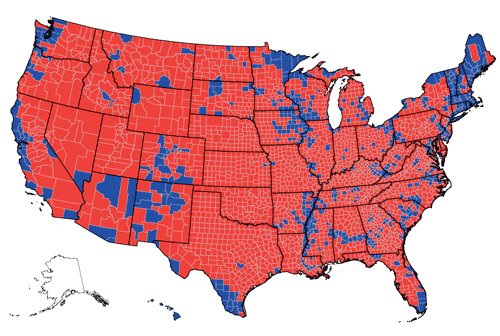
Elevation map of the United States
2004 Election results by county

Because if the oceans rise 20 feet, they won't be the ones who suffer.

[That's all, folks]

Wednesday, December 28, 2005

Credit Where Credit Is Due

Before everyone forgets about our victory on ANWR, I just wanted to point out that one of the heroes of the story was good old Holy Joe Lieberman. Lieberman has consistently been on the right side on ANWR, and on environmental issues in general.

None of this excuses any of the really appalling things he has done: excusing torture, attacking his fellow Democrats on national security issues, getting chummy with Bush, and so on. Lieberman is in many ways the very definition of a 'self-hating Democrat', and over the years he has caused enormous harm to the party (and, more to the point, to the causes the party is supposed to represent).

But if I'm going to excoriate Lieberman for the bad he does, then honesty compels me to give him credit when he takes a stand on the right side. (And I think his history of support for environmental causes gives ample evidence that this is a heartfelt stand, and not just trying to curry favor with the Democratic base.) I still think on balance he's probably done more harm than good, and I would still like to see someone better in his seat. None of that has changed.

But for now, on this issue, on this vote: good for him.

[That's all, folks]